How to Keep Score in Dominoes: The House Method, Line by Line
Somebody's drawing little shapes on a napkin and everybody at the table can read them. Here's the house: what each mark means, how it builds to 50, and how three of them make a game.
Fives is the only common domino game where you're scoring on nearly every other play, so it needs a score sheet, and the sheet needs to be readable across a table by people who are arguing. The house method solved that a long time ago. You don't write numbers. You draw lines, and the shape they make tells everyone the score at a glance.
If you're not sure how the points happen in the first place, read Dominoes Scoring: Counting the Open Ends first. This page is about writing them down.
Why paper works for Fives
Every score in Fives is a multiple of 5. That's the whole rule: the open ends have to total 5, 10, 15, 20 and so on, or you get nothing. When somebody dominoes, the other side's leftover pips are rounded to the nearest 5. When a hand is blocked, the difference is rounded to the nearest 5. There is no play in the game that pays 7 or 12.
So a single stroke of the pen can stand for 5 points, and a game to 150 is exactly 30 strokes. You never carry a number, never do arithmetic at the table, and nobody has to squint at a 7 that might be a 1. You just count lines.
The house, line by line
The house is a ten-line figure. Every line is 5 points. The version we use goes like this:
- Two long lines first. That's your first 10 points, one line for 5, the second for 10.
- Then the corners. Each of the four corners gets two short diagonal lines. Eight more strokes, 40 more points.
- Ten lines, 50 points. The figure is closed. That's a house. Start the next one below it.
So a dime is two strokes. Trees is three. A twenty is four, and if that twenty takes you from 40 to 60 you close one house with two lines and open the next house with two more. A nick is a single line, which is why a table full of nicks is a slow, scratchy table.
The strokes vary. The count doesn't. Some tables draw a box first and then put an X through it. Some draw walls and then a roof. Some mark a small circle for 10 instead of two lines. We've never sat at a table where a line was worth anything but 5 or a finished figure worth anything but 50. If you're at a new table, watch the first dime get written down and you'll know their shape in two seconds.
Setting up the sheet
One line down the middle of the paper. Left column, one side. Right column, the other. Names at the top, or initials, or "us" and "them." Partners share a column. That's the whole setup, and it's why a napkin, the back of a paper plate, or the margin of a newspaper all work fine.
Houses stack downward in each column. Three houses in your column and you're at 150. At a table that plays to 200 it's four; at 250, five. Our house is three houses, and the reason 150 feels so natural on paper is exactly this: three clean figures, readable from across the yard.
The rules of the pen
The sheet keeps the score. The pen keeps the peace. At most tables these are the working rules, and they're worth saying out loud at a new one.
- Call every score. The player says it when they play it: "dime," "trees," "gimme fifteen." The pen repeats it back while writing. A score nobody called is a score nobody gets to argue about later, and at some tables it's a score you don't get at all.
- Dispute it now or never. If anyone doubts a count, the pen recounts the open ends on the board immediately, before the next bone goes down. Once the next play is made, the board has changed and the number stands.
- The pen is final. Not because the pen is always right, but because a game where the score is up for renegotiation every hand is not a game.
- Who holds it: someone everybody trusts, a spectator who isn't playing, or the person who just lost and needs something to do with their hands. Handing the pen to the loser is a small kindness that also keeps them at the table.
- The pen calls the number, not the play. "You're at 95, they're at 110" is the pen's job. "You should've played the six" is not.
If you'd rather just write numbers
Nothing wrong with a plain running tally. Two columns, write each score, keep a running total underneath: 10, 15, 35, 40. It's what most of us do on a phone's notes app when there's no paper. The house method wins on one thing only, and it's the thing that matters at a loud table: everyone can read it from a distance without doing math. Three houses and a stroke means 155 to anybody, from anywhere in the yard, upside down. A column of digits doesn't.
Take-Pen: the house, without the argument
We built Take-Pen because we kept losing the napkin. It's a scorekeeper, not a game: two sides, your names, and a row of chips that match how people actually call the score. Tap NICK for 5, DIME for 10, TREES for 15, TWENTY for 20, or key in a bigger one when somebody hits a quarter. Undo takes back the last tap when the table decides the count was wrong. The game ends itself at 150, or whatever number your house plays, and the result is saved so next Sunday there's a record of who really won.
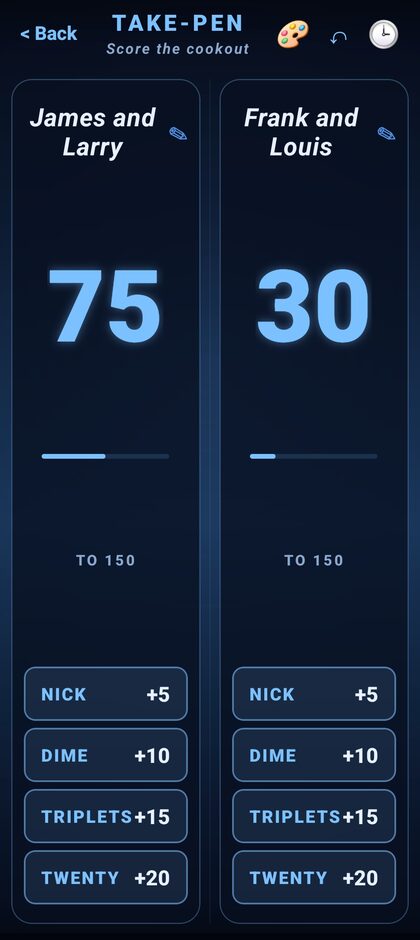
The pen rules still apply. Somebody holds the phone, everybody calls their score, disputes get settled before the next bone. The only thing that changes is that nobody has to squint at the corner of a house to figure out whether that was 40 or 45.
Questions people ask
What is a house in dominoes?
A house is the figure players draw on a paper score sheet to track points in Fives. Every line in it is worth 5 points, and when the figure is complete it stands for 50. Three finished houses is 150, which is game at most tables.
How many points is a house in dominoes?
Fifty. A house is ten lines at 5 points each. Some tables draw it differently, but the count is the same everywhere we know of: line equals 5, house equals 50.
How do you keep score in dominoes on paper?
Draw a line down the middle of the sheet, one column per player or team. Each time somebody scores, add lines to their column, one line per 5 points, building a house. When a house has ten lines it is complete and worth 50; start the next one below it. Three houses wins.
Why are dominoes scores always multiples of 5?
Because in Fives you only score when the open ends add up to a multiple of 5, and go-out and blocked-hand points are rounded to the nearest 5. Since every score lands on a 5, a single line can stand for 5 points and the whole game fits in tally marks.
Who keeps score in dominoes?
Whoever holds the pen. At most tables that is a trusted player, a spectator, or the person who just lost. The pen calls the score back after every play, recounts the board immediately if anyone disputes it, and once the next bone is played the pen's number is final.
Is there an app for keeping score in dominoes?
Yes. Cookout Dominoes includes Take-Pen, a scorekeeper for live games with real bones: tap NICK, DIME, TREES or TWENTY for each side, undo mistakes, see first-to-150 progress, and save the history of who beat whom.